
Training at least once a year
The occupier of the workplace holds risk-prevention training and repeats it "according to the employees' needs and at least once a year" (regulation 3(a)).
Workplace safety
The occupier of a workplace must train the employees on the risks of the work at least once a year, make sure they understood, and document the training. On this page: what the regulations require, what changed with the amendment that came into force on 16 October 2026, and how to manage all of it in one place.
Written by Roman Bok, certified safety officer and certified work-at-height instructor · Updated: October 2026

The occupier of the workplace holds risk-prevention training and repeats it "according to the employees' needs and at least once a year" (regulation 3(a)).
Measures must be taken to make sure the employees understood the training properly (regulation 3(b)).
The training is recorded in a training register kept at the workplace. From 16.10.2026 the register also records the ID number, passport number or other government identifier of every employee who took part (regulations 6(1A) and 6A).
Training through an e-learning course is carried out in a language the employee understands; online training — in a language the employee understands, or with the help of means of translation into such a language (regulation 3(a3)).
Source: the Labour Inspection Organisation (Provision of Information and Training of Employees) Regulations, 1999, as amended by the Amending Regulations, 2026 — Kovetz HaTakanot 12471, 14.7.2026.
The amendment to the regulations applies to every training held from 16.10.2026 onwards.
The default is face-to-face (in-person) training (regulation 3(a2)).
Online training or training through an e-learning course is permitted at a workplace that has an appointed safety officer, provided that the safety officer has confirmed on the Second Schedule form that the training may be held in this way. The signed form is attached to the training register.
A workplace carrying out building or engineering construction work that requires notice under section 192 of the Work Safety Ordinance may not hold the training this way.
A declaration by the "suitable professional" who conducted the training, on the First Schedule form, is attached to the training register (regulation 3(a1)).
An e-learning course must be one prepared by a suitable professional, in a language the employee understands, and it must make it possible to identify the employee, track the training and document it (regulation 3(a3)).
In plain terms: if no safety officer has been appointed at the workplace, or the safety officer has not confirmed this on the Second Schedule form, the annual training must be face-to-face. The same applies to a workplace carrying out building or engineering construction work that requires notice under section 192 of the Work Safety Ordinance.
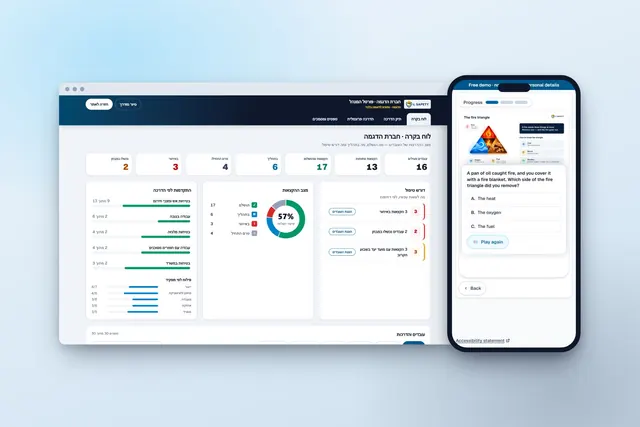
The training is assigned to employees by role, department and risk.
Each employee receives a personal link by email, SMS or WhatsApp, or gets in through the company's web address — with no password.
Structured chapters with narration, images, video and questions, in the language the employee chooses from the training's languages that the company enables.
At the end of the training the employee answers questions. The answers and the score are saved.
The employee confirms that they received the training and understood it, and signs.
A completion certificate for the employee, and an entry in the training register.
One screen showing who has completed, who is in progress and who has not started yet.
Training register: the employee's name, ID number, passport number or government identifier, start and completion dates, the training language and the employee's signature.
The First and Second Schedule forms in their official wording, for the suitable professional and the appointed safety officer to sign, then attached to the training register.
Completion certificates, exam results and training history for every employee.
Training validity: who is up to date, whose validity ends soon and whose has already expired.
Sending a reminder to employees who have not yet completed the training.
The system works in ten languages: Hebrew, English, Russian, German, Spanish, Arabic, Amharic, Thai, Chinese and Hindi. The ready-made safety trainings exist only in the languages prepared for them: for office staff in Hebrew, English, Russian, German, Spanish and Arabic, and for warehouse staff in Hebrew, Russian and Amharic. The employee chooses from the training's languages and gets the same content, the same exam and the same records — without relying on a co-worker to translate. The translations into Arabic, Amharic, Thai, Chinese and Hindi are still awaiting review by a native speaker.
From 16.10.2026, only at a workplace that has an appointed safety officer, and on condition that the safety officer has confirmed on the Second Schedule form that the training may be held as online training or through an e-learning course. A workplace carrying out building or engineering construction work that requires notice under section 192 of the Work Safety Ordinance may not do so. In every other case the training is face-to-face.
The workplace's appointed safety officer. On the form, the safety officer specifies the subject of the training and whom it covers: all employees, or the employees in a particular field.
A person with experience, skills and training in the subject of the training, who has signed a declaration on the First Schedule form. Their declaration is attached to the training register.
Among other things, the details of the training and of the employees who took part in it, and from 16.10.2026 also the ID number, passport number or other government identifier of every participant. The suitable professional's declaration is attached to it, and for online training or an e-learning course, the signed Second Schedule form as well.
It can be documented in the system too: at a group training session each participant signs individually, in their own language, on their own phone or on the instructor's device, and a single document is produced with all the signatures. The digital training itself can also be shown in the classroom, on a projector: employees answer the questions from their phones, and at the end an attendance list and a session report are saved.
No. The decision whether the training can be held as an e-learning course is the appointed safety officer's, and the training is conducted by a suitable professional. The system delivers the training to the employees, checks understanding, collects signatures and organises the records.
Leave your details and we will get back to you, or try a sample training yourself. Try a sample training
What to check before choosing an online safety training platform, what it does not do, and when Israeli law allows safety training by e-learning.

Present a training from the system on a projector; employees answer on their phones in their own language, and an attendance list and a session report are saved.

Foreign workers, new immigrants and multilingual teams: each employee chooses their language and gets the same content, the same exam and the same records.

A training register under the regulations with the Schedule forms, and records for every employee — signed lists, employee files and Excel — ready for an inspection.

The First Schedule and Second Schedule forms of the regulations, in their official wording — blank, for printing, free of charge.

A safety training attendance sheet and an employee training record — blank PDF templates to print, free of charge, in ten languages.

Training for every employee in their own language: the prohibition in the law, the code of conduct and the details of the organisation's person in charge of complaints, acknowledged and signed.

Procedures, work instructions and the requirements of a standard: every employee learns, is tested and confirms, and the records are ready for audit.

A Word procedure becomes an accessible page on the phone: the employee reads, takes a short quiz and signs, and a signed receipt is kept for each employee.

Every training a new employee needs — safety, procedures and harassment prevention — in one assignment and in their own language.

From your presentation, procedure or know-how — a digital course with narration, an exam and versions in your employees' languages.
The information on this page is a general summary and is not legal advice. The binding text is the text of the regulations as published in Reshumot, the official gazette.