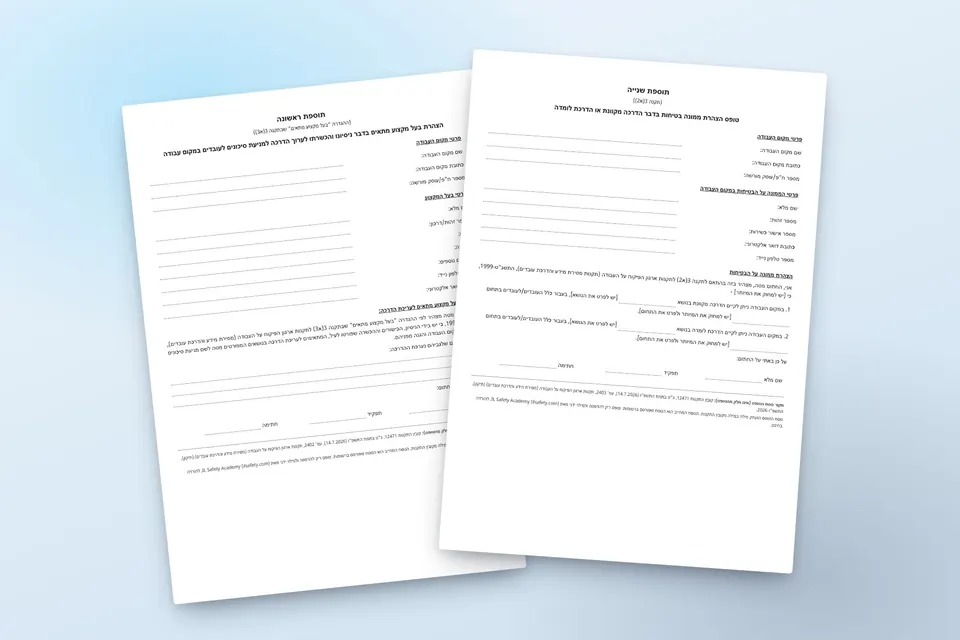
The First and Second Schedule forms for employee training: the official wording, free to download
From 16 October 2026, the declaration of the suitable professional who conducted the training (the First Schedule) is attached to the training register, and for online training or an e-learning course, the safety officer's declaration (the Second Schedule) as well. Here you can download both forms in their official wording, and read when each one is needed and who signs it.
Written by Roman Bok, certified safety officer and certified work-at-height instructor · Updated: October 2026
The two forms added to the regulations by the amendment that came into force on 16.10.2026, in their official wording, blank for printing and filling in by hand — free of charge, with no registration.
First Schedule — declaration of a suitable professional
The declaration of the professional who conducts the training on their experience, skills and training, with the workplace details and a list of the training subjects. It is attached to the training register (regulation 3(a1)).
Second Schedule — safety officer's declaration on online training or an e-learning course
The appointed safety officer's declaration that online training or training through an e-learning course on a particular subject may be held at the workplace, for all employees or for the employees in a particular field. It is signed and attached to the training register (regulation 3(a2)).
The wording of the forms is copied word for word from Kovetz HaTakanot 12471 (14.7.2026), pp. 2402–2403. The binding text is the text published in Reshumot, the official gazette.
When each form is needed
Suitable professional
The training is conducted by a suitable professional — a person with experience, skills and training in the subject of the training, who has signed a declaration on the First Schedule form (regulation 3(a3)).
The declaration is attached to the register
The declaration of the suitable professional who conducted the training stays attached to the training register until an updated training on the same subject is held (regulation 3(a1)).
Online training or an e-learning course — with the safety officer's approval
Online training or training through an e-learning course is permitted at a workplace that has an appointed safety officer, provided that the safety officer has confirmed on the Second Schedule form that the training may be held in this way. The signed form is attached to the training register (regulation 3(a2)).
Not for construction work that requires notice
A workplace carrying out building or engineering construction work that requires notice under section 192 of the Work Safety Ordinance may not hold the training as online training or through an e-learning course.
Source: the Labour Inspection Organisation (Provision of Information and Training of Employees) Regulations, 1999, regulation 3 and the First and Second Schedules, as amended by the Amending Regulations, 2026 — Kovetz HaTakanot 12471, 14.7.2026.
How to use the forms
1
Download and print
Download the form you need and print it.
2
Workplace details
Fill in the name of the workplace, its address and the company registration number or licensed dealer (Osek Murshe) number.
3
The professional declares
The suitable professional fills in their details, their experience and training, and the training subjects, and signs the First Schedule personally.
4
The safety officer confirms
For online training or an e-learning course, the appointed safety officer fills in the Second Schedule: the subject, and whom the training is for — all employees or employees in a particular field — deletes whichever does not apply, and signs.
5
Attach to the register
The signed forms are attached to the training register, which is kept within the workplace.
What each form contains
First Schedule: the workplace details — name, address and company registration number or licensed dealer (Osek Murshe) number.
First Schedule: the professional's details — full name, ID or passport number, experience, training, additional skills, mobile phone and email.
First Schedule: the declaration, a list of the subjects on which the training is given, and a signature with full name and role.
Second Schedule: the workplace details and the safety officer's details — full name, ID number, competence certificate number, email and mobile phone.
Second Schedule: the declaration that online training or training through an e-learning course on a particular subject may be held at the workplace, for all employees or for the employees in a particular field — the form says to delete whichever does not apply — and a signature with full name and role.
Or without paper
In the system, the forms are prepared in their official wording with the workplace details. The professional and the safety officer sign personally — from a personal link with a code sent to their email, or on a printed copy that is scanned — and the forms are attached to the training register the system produces.
Frequently asked questions
When is the Second Schedule form needed?
When the training is held as online training or through an e-learning course. From 16.10.2026 this is permitted only at a workplace that has an appointed safety officer, and on condition that the safety officer has confirmed on the Second Schedule form that the training may be held in this way. A workplace carrying out building or engineering construction work that requires notice under section 192 of the Work Safety Ordinance may not do so.
Who signs the First Schedule form?
The suitable professional who conducted the training — a person with experience, skills and training in the subject of the training. They sign it personally, and the declaration stays attached to the training register until an updated training on the same subject is held.
Who signs the Second Schedule form?
The workplace's appointed safety officer. On the form, the safety officer specifies the subject of the training and whom it covers: all employees, or the employees in a particular field.
Where are the signed forms kept?
They are attached to the training register. The register is kept within the workplace; at a workplace where building or engineering construction work is carried out — at the construction site where the employee works (regulation 6A).
Are the forms here the official wording?
Yes. The wording is copied word for word from Kovetz HaTakanot 12471 (14.7.2026), pp. 2402–2403, without any change. The binding text is the text published in Reshumot, the official gazette.
Can the forms be signed without printing them?
In the system, yes: the forms are prepared in their official wording, the professional and the safety officer sign personally from a personal link with a code sent to their email, and the forms are attached to the training register the system produces. The details are on the Training register and records page.
Want the forms signed and attached to the register without paper?
Leave your details and we will get back to you, or try a sample training yourself. Try a sample training
Present a training from the system on a projector; employees answer on their phones in their own language, and an attendance list and a session report are saved.
Foreign workers, new immigrants and multilingual teams: each employee chooses their language and gets the same content, the same exam and the same records.
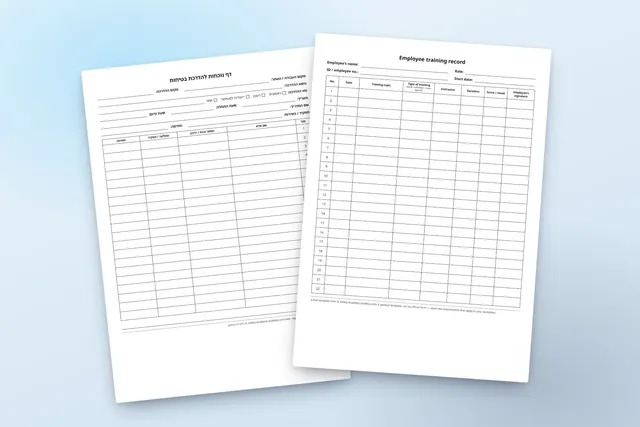
A training register under the regulations with the Schedule forms, and records for every employee — signed lists, employee files and Excel — ready for an inspection.
Training for every employee in their own language: the prohibition in the law, the code of conduct and the details of the organisation's person in charge of complaints, acknowledged and signed.
A Word procedure becomes an accessible page on the phone: the employee reads, takes a short quiz and signs, and a signed receipt is kept for each employee.
From your presentation, procedure or know-how — a digital course with narration, an exam and versions in your employees' languages.
The information on this page is a general summary and is not legal advice. The binding text is the text of the regulations as published in Reshumot, the official gazette.