
Up-to-date work instructions
The occupier of a workplace gives the employee up-to-date instructions for the safe use, operation and maintenance of the equipment, materials and work processes at the workplace (regulation 2).
Procedures to read and sign
A procedure sent by email or pinned to the notice board does not show who read it. Here the procedure you wrote in Word becomes a page that is easy to read on a phone, the employee answers a short quiz before signing, and at the end you hold a signed receipt for every employee — and one screen that shows who has not signed yet.
Written by Roman Bok, certified safety officer and certified work-at-height instructor · Updated: October 2026

Some of the obligations in the regulations and in quality standards are not only about writing procedures and instructions, but about bringing them to the employees.
The occupier of a workplace gives the employee up-to-date instructions for the safe use, operation and maintenance of the equipment, materials and work processes at the workplace (regulation 2).
No later than the day they start work, the employee receives a written summary of the risks of their work, in Hebrew and in another language they understand — and a new summary when their role or workstation changes (regulation 7).
Employees need to be aware of the quality policy, the relevant objectives, their own contribution and the implications of not conforming with the requirements (ISO 9001, clause 7.3).
In an audit you are asked not only whether a procedure exists, but who received it, which version and when. A signed receipt for each employee answers that question.
Source: the Labour Inspection Organisation (Provision of Information and Training of Employees) Regulations, 1999, regulations 2 and 7, as amended by the Amending Regulations, 2026 — Kovetz HaTakanot 12471, 14.7.2026; ISO 9001:2015, clause 7.3. The exact requirements of a standard depend on the standard the organisation is certified to and on the scope of the certification.
A Word file is saved as a draft. The headings, numbering, tables and images are kept, and the system finds where details are filled in and where to sign.
You see exactly what the employees will receive, before anything is sent.
You choose how many questions, and the system suggests questions from the procedure itself. You go through them, correct them and approve.
To all employees, a site, a department or specific employees, with a due date. Employees receive a personal link to the procedure by email, with no password, or find it in the employee area at the company's web address.
The employee reads on their phone and answers the questions. Their name, the date and their ID number are filled in from the employee's details, and they sign with a finger or by typing their name.
One screen shows who has signed the current version and who has not, and you send a reminder to anyone who has not signed.
A signature shows the employee confirmed. A short quiz shows they also read the important points.
The system drafts questions from the procedure itself, with the help of artificial intelligence. Each question rests on a passage quoted word for word from the procedure, and a question without such a passage is rejected.
Choose from one to 15 questions and the pass mark, edit every question and answer, or write the quiz yourself. The quiz reaches employees only after it is switched on.
The signature opens only after the employee has passed the quiz. Anyone who did not pass sees how many answers were right and which questions they got wrong, and tries again.
Every attempt is kept with the questions as they were answered, and the quiz result appears on the employee's signed receipt.
Who has signed the current version, who has not, and the quiz results for each employee.
A signed receipt for each employee (PDF): which version, when it was opened and when it was signed, the details filled in, the signature, the quiz result and the full text of the procedure.
A repeat signing round every 6, 12 or 24 months: on the set date a new version of the procedure is issued, and every employee is asked to sign it.
An updated procedure is issued as a new version; the previous version and the signatures on it are kept.
Sending an email reminder to anyone who has not signed yet.
The procedure is shown as a real page — with headings, lists, tables and a description for every image — so a screen reader can read it too. The instructions and buttons on the page appear in the employee's language, in one of the system's ten languages; the procedure itself is shown as you wrote it.
A signature alone shows the employee confirmed. A short comprehension quiz before the signature shows they also read the important points: the signature opens only after a pass, every attempt is kept, and the result appears on their signed receipt.
A Word file. The system keeps the headings, numbering, lists, tables and images, and checks that not a single word was lost on the way. If something in the file cannot come through properly — for example tracked changes that were not accepted, or a scanned file with no text — the procedure is not published, and the message explains what to fix in Word.
Yes. The system finds the places to fill in in the procedure — name, date, ID number, signature and checkboxes — and fills in the name, the date and the ID number itself from the employee's details. A place meant for someone else's signature, such as a supervisor's, is not shown to the employee as theirs.
No. The procedure is shown as you wrote it, in whatever language it is written in. If your employees need it in another language, you publish your translated version and assign it to the employees who need it. The instructions and buttons on the page appear in the employee's language.
For each procedure you set whether to repeat it every 6, 12 or 24 months. On the set date a new version of the same procedure is issued and the employees are asked to sign again; the comprehension quiz carries over to it. You can also start a round straight away.
A library in which IL Safety Academy prepares a procedure once and assigns it to several companies. Each company gets its own copy as a draft — with the comprehension quiz, if it has one — and it is not sent to employees until it is published in that company. When the procedure in the library is updated, the new version arrives again as a draft, and the signatures on the previous version are kept.
Leave your details and we will get back to you, or try a sample training yourself. Try a sample training

Annual safety training by role and risk, with a training register and the First and Second Schedule forms under the regulations.
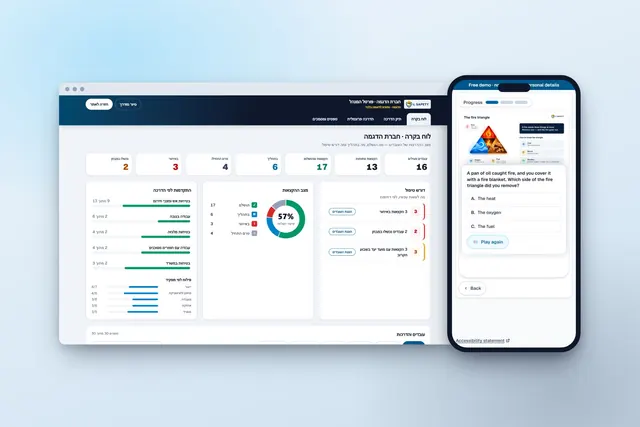
What to check before choosing an online safety training platform, what it does not do, and when Israeli law allows safety training by e-learning.

Present a training from the system on a projector; employees answer on their phones in their own language, and an attendance list and a session report are saved.

Foreign workers, new immigrants and multilingual teams: each employee chooses their language and gets the same content, the same exam and the same records.

A training register under the regulations with the Schedule forms, and records for every employee — signed lists, employee files and Excel — ready for an inspection.
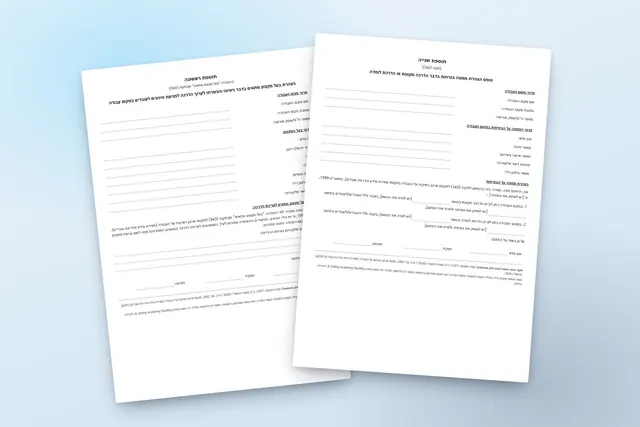
The First Schedule and Second Schedule forms of the regulations, in their official wording — blank, for printing, free of charge.
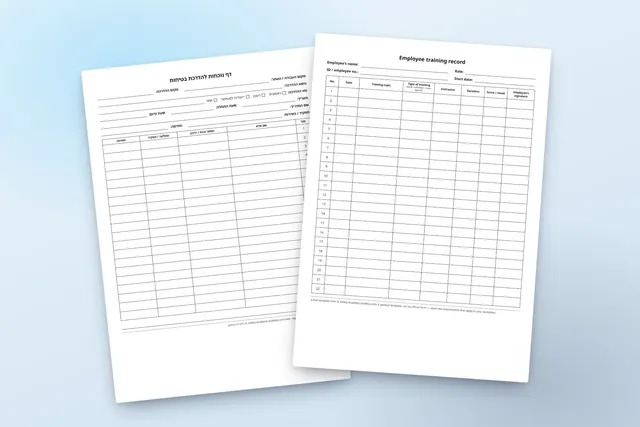
A safety training attendance sheet and an employee training record — blank PDF templates to print, free of charge, in ten languages.

Training for every employee in their own language: the prohibition in the law, the code of conduct and the details of the organisation's person in charge of complaints, acknowledged and signed.

Procedures, work instructions and the requirements of a standard: every employee learns, is tested and confirms, and the records are ready for audit.

Every training a new employee needs — safety, procedures and harassment prevention — in one assignment and in their own language.

From your presentation, procedure or know-how — a digital course with narration, an exam and versions in your employees' languages.
The information on this page is a general summary and is not legal advice. The binding text is the text of the regulations as published in Reshumot, the official gazette.