
A ready-made training library
Annual safety training for office and warehouse staff, prevention of sexual harassment at work and more — in every language each one is available in, included in the subscription.
Safety e-learning
Safety e-learning is digital safety training that each employee completes on their own, on a phone or a computer. On this page: what to check before choosing an online safety training platform, what IL Safety Academy does and does not do, and — for workplaces in Israel — what the regulations say about e-learning from 16 October 2026.
Written by Roman Bok, certified safety officer and certified work-at-height instructor · Updated: November 2026
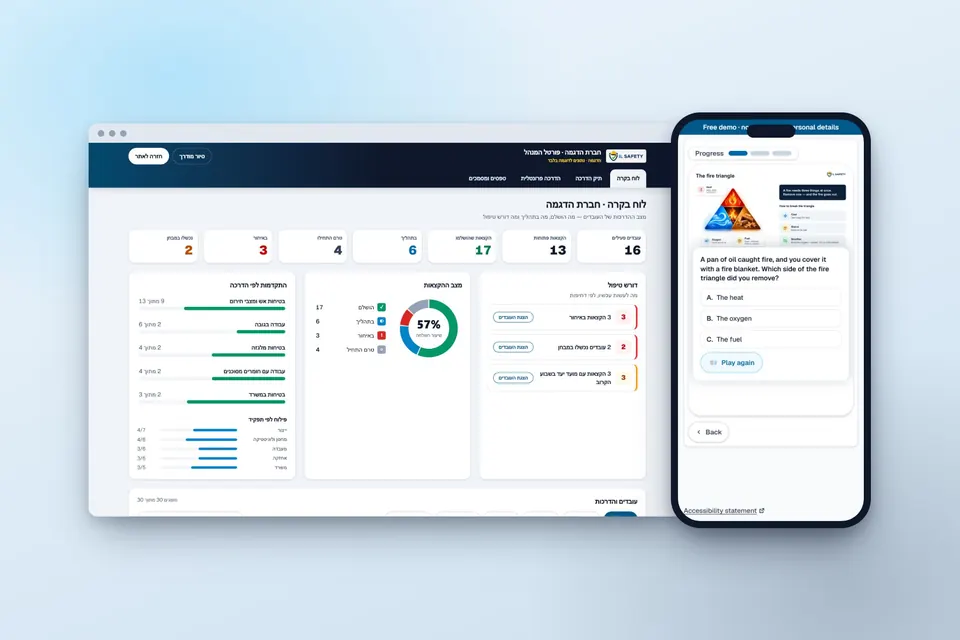
An employee training system in which every employee gets the training on their phone, in the language they choose from the training's languages that the company enables, answers questions, takes an exam and signs — and the company's manager sees who has completed and produces the training records and reports.
A library of ready-made trainings: annual safety training for office and warehouse staff, prevention of sexual harassment at work and more.
Access with a personal link, with no password and no app.
Records for every employee and a certificate for each completed training — and in Israel, a training register under regulation 6 with the official First and Second Schedule forms.
When training has to be face-to-face, the instructor delivers the same training in the classroom.
An annual subscription by the number of active employees: from $29 a month, billed annually, before local taxes.
For workplaces in Israel. The amendment to the regulations applies to every training held from 16.10.2026 onwards.
The default is face-to-face (in-person) training (regulation 3(a2)).
Online training or training through an e-learning course is permitted at a workplace that has an appointed safety officer, provided that the safety officer has confirmed on the Second Schedule form that the training may be held in this way. The signed form is attached to the training register.
The confirmation on the Second Schedule form relates to the subject of the training and to the employees the safety officer specified on the form: all employees, or the employees in a particular field.
A workplace carrying out building or engineering construction work that requires notice under section 192 of the Work Safety Ordinance may not hold the training this way.
A declaration by the "suitable professional" who conducted the training, on the First Schedule form, is attached to the training register (regulation 3(a1)).
An e-learning course must be one prepared by a suitable professional, in a language the employee understands, and it must make it possible to identify the employee, track the training and document it (regulation 3(a3)).
In plain terms: if no safety officer has been appointed at the workplace, or the safety officer has not confirmed this on the Second Schedule form, the annual training must be face-to-face. The same applies to a workplace carrying out building or engineering construction work that requires notice under section 192 of the Work Safety Ordinance. An exam, the employee's signature and a completion certificate are not part of the regulations' definition of e-learning; in IL Safety Academy they are features of the system.
Source: the Labour Inspection Organisation (Provision of Information and Training of Employees) Regulations, 1999, regulation 3 and the First and Second Schedules, as amended by the Amending Regulations, 2026 — Kovetz HaTakanot 12471, 14.7.2026.
Languages: not only which languages the platform works in, but which languages each training you need actually exists in — and whether the employee gets the whole training in their language: narration, questions, exam and declaration.
Identification, tracking and records: can you tell who took the training, follow it and document it? In Israel the regulations require this of an e-learning course (regulation 3(a3)).
Simple access: a personal link on the phone, with no password and no app. An employee who struggles to get in does not finish the training.
Checking understanding: questions and an exam help, but a digital exam alone does not guarantee that the employee understood the risks and acts on the training. In Israel, measures must be taken to make sure the employees understood the training properly and act on it (regulation 3(b)).
A declaration, a signature and a certificate for every employee: they record what each employee confirmed. In Israel they are not part of the regulations' definition of e-learning.
A training register: who took part and each one's identifier, the dates, the type and subject of the training, and who conducted it. In Israel this is what regulation 6 requires, including the name, competence and role of the suitable professional.
Validity and reminders: who is up to date, whose validity ends soon, and a reminder to anyone who has not finished.
The classroom too: when training must be face-to-face, does the same system document it as well?
Export for audits, and the register at the workplace: PDF and Excel files you produce yourself at any time, without asking the vendor, and a register you can print. In Israel, the register is kept within the workplace; at a workplace where building or engineering construction work is carried out — at the construction site where the employee works (regulation 6A).
A transparent price and a trial before you commit: what the price includes — library, languages, setup — and whether the monthly price is billed annually and before taxes.
An e-learning system does not decide whether a training may be given as e-learning, and it does not replace the safety officer or the suitable professional. It delivers the training to the employees, asks questions and an exam, collects signatures and organises the records.
Annual safety training for office and warehouse staff, prevention of sexual harassment at work and more — in every language each one is available in, included in the subscription.
The training, exam, declaration and signature screens exist in Hebrew, English, Russian, German, Spanish, Arabic, Amharic, Thai, Chinese and Hindi. Each ready-made training is available only in the languages prepared for it. The translations into Arabic, Amharic, Thai, Chinese and Hindi are still awaiting review by a native speaker.
A personal link by email, SMS or WhatsApp, or access from the company's web address with a one-time code.
A comprehension exam with a score, a declaration signed with a finger, and a PDF completion certificate — features of the system, not part of the Israeli regulations' definition of e-learning.
In Israel, the company's manager produces the regulation-6 training register themselves (a PDF in Hebrew), for the whole company or one site, from the trainings employees completed in the system: for every subject the type of training, and the name, competence and role of the suitable professional from their First Schedule declaration; for every employee their name, identifier, dates, language and signature. The signed Schedule forms are attached.
The instructor shows the training on a screen, and every employee answers from their phone in their own language. An attendance list and a session report are saved.
So there are no surprises:
It does not decide whether you may give the training as e-learning. In Israel that is the appointed safety officer's decision, on the Second Schedule form.
A digital exam alone does not guarantee that the employee understood the risks and acts on the training.
E-learning does not replace practical training, a specific certification or site-specific instruction at the workplace where these are required.
It does not replace the additional training for foreign workers in construction in Israel: at least eight hours, at one of the training institutions listed in regulation 3A.
Classroom training is not recorded in the training register the system produces, and employees do not receive a certificate for it: an attendance list and a session report are saved.
A custom training built from your materials is a service with a one-off payment: we build it, and the price depends on its length. Another language of it is a complete version at an additional cost, built in advance, not machine translation during the training.
Digital safety training that each employee completes on their own, on a phone or a computer. Under the Israeli regulations, an e-learning course must be one prepared by a suitable professional, in a language the employee understands, and it must make it possible to identify the employee, track the training and document it. An exam, a signed declaration and a completion certificate are not part of that definition; in IL Safety Academy they are features the system adds.
It depends on the rules where you work. In Israel, from 16.10.2026, only at a workplace that has an appointed safety officer, and on condition that the safety officer has confirmed on the Second Schedule form that the training may be held as online training or through an e-learning course, for the subject and the employees specified on the form. A workplace carrying out building or engineering construction work that requires notice under section 192 of the Work Safety Ordinance may not do so. In every other case the training is face-to-face. Even where e-learning is permitted, it does not replace practical training, a specific certification or site-specific instruction at the workplace where these are required. The details are on the page on annual safety training.
The system works in ten languages: Hebrew, English, Russian, German, Spanish, Arabic, Amharic, Thai, Chinese and Hindi. Each ready-made training is available only in the languages prepared for it, not necessarily in all ten. The translations into Arabic, Amharic, Thai, Chinese and Hindi are still awaiting review by a native speaker. The employee chooses from the training's languages that the company enables, and gets the training, the exam and the declaration in that language. The details are on the page on training in the employee's language.
No. The employee receives a personal link by email, SMS or WhatsApp, or gets in from the company's web address with a one-time code.
In Israel, under regulation 6: the names of the employees who took part, each one's ID number, passport number or government identifier, the dates of the training, its type and subject, and the name, competence and role of the suitable professional. The register is kept within the workplace; at a workplace where building or engineering construction work is carried out — at the construction site where the employee works (regulation 6A). In the system, the company's manager produces the register as a PDF, for the whole company or one site, with the First Schedule declaration and the Second Schedule form attached, and can print it and keep it at the workplace. The register covers the trainings employees completed in the system; classroom training is documented by an attendance list and a session report. The details are on the page on the training register and records.
An annual subscription by the number of active employees: from $29 a month for a company of up to 10 employees, billed annually, before local taxes. Every ready-made training in the library, in every language it has, the exams, signatures and records are included, with no setup fee. You can start with a 14-day trial for up to 10 employees. The full price list is published on the pricing page.
Yes, as a service: a procedure, a presentation, a work instruction or a lesson from an incident becomes a training with narration, questions during the training, an exam, a declaration and a certificate. The payment is one-off, and the price depends on its length. The details are on the page on custom courses.
Yes. On the demo page you can take a sample training with no sign-up and without giving any personal details, and there is also a tour of a sample company's manager portal.
Leave your details and we will get back to you, or try a sample training yourself. Try a sample training

Annual safety training by role and risk, with a training register and the First and Second Schedule forms under the regulations.

Present a training from the system on a projector; employees answer on their phones in their own language, and an attendance list and a session report are saved.

Foreign workers, new immigrants and multilingual teams: each employee chooses their language and gets the same content, the same exam and the same records.

A training register under the regulations with the Schedule forms, and records for every employee — signed lists, employee files and Excel — ready for an inspection.
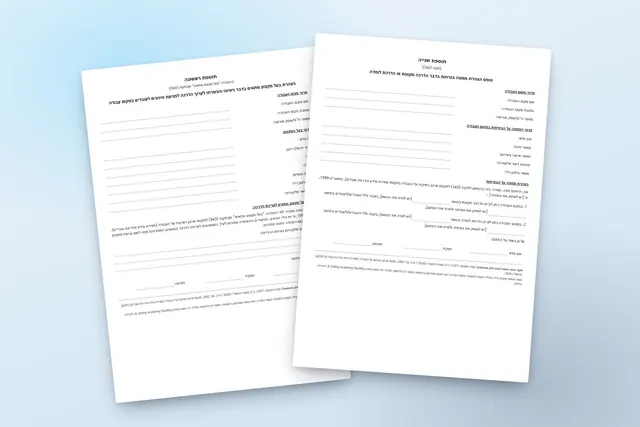
The First Schedule and Second Schedule forms of the regulations, in their official wording — blank, for printing, free of charge.
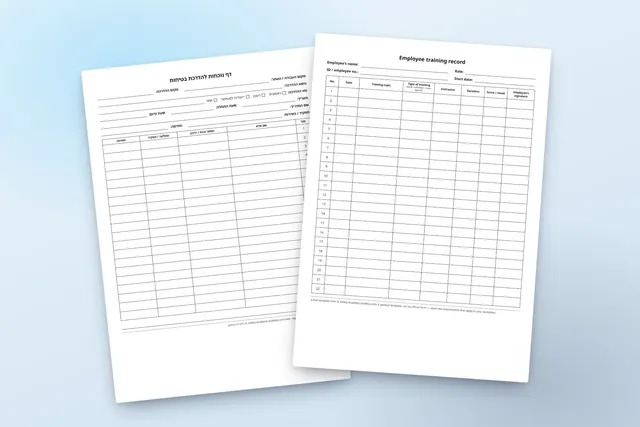
A safety training attendance sheet and an employee training record — blank PDF templates to print, free of charge, in ten languages.

Training for every employee in their own language: the prohibition in the law, the code of conduct and the details of the organisation's person in charge of complaints, acknowledged and signed.

Procedures, work instructions and the requirements of a standard: every employee learns, is tested and confirms, and the records are ready for audit.

A Word procedure becomes an accessible page on the phone: the employee reads, takes a short quiz and signs, and a signed receipt is kept for each employee.

Every training a new employee needs — safety, procedures and harassment prevention — in one assignment and in their own language.

From your presentation, procedure or know-how — a digital course with narration, an exam and versions in your employees' languages.
The information on this page is a general summary and is not legal advice. The binding text is the text of the regulations as published in Reshumot, the official gazette.