
Evidence of competence
The organisation determines the competence required, ensures that employees acquire it and retains documented information as evidence of competence (ISO 9001, clause 7.2).
Quality and work procedures
A procedure sent by email does not prove that anyone read it. When the procedure becomes a short training with a comprehension exam and a signature, you hold evidence for every employee: what they learned, when, in which language, and whether they understood.
Written by Roman Bok, certified safety officer and certified work-at-height instructor · Updated: October 2026

Common management standards require not only training, but also showing that employees are competent for their work.
The organisation determines the competence required, ensures that employees acquire it and retains documented information as evidence of competence (ISO 9001, clause 7.2).
When you train to achieve competence, you evaluate whether the training achieved its aim (ISO 9001, clause 7.2(c)). A comprehension exam is one way to do this.
Employees need to be aware of the quality policy, the relevant objectives, their own contribution and the implications of not conforming with the requirements (ISO 9001, clause 7.3).
In an audit you are asked who was trained, on which procedure and on what date. With an orderly training file, the answer comes from a single report.
Source: ISO 9001:2015, clauses 7.2 (competence) and 7.3 (awareness). The exact requirements depend on the standard the organisation is certified to and on the scope of the certification.
An existing document, presentation, work instruction or video — that is the starting point.
We build it into structured chapters with images, narration and questions, in the order the work is done in the field.
The training is assigned only to the employees the procedure concerns: a department, team or role.
Questions on the critical points of the procedure. The answers and the score are saved.
The employee confirms that they learned and understood the procedure, and signs.
Who has completed, who has not, and when — for every training and every employee, with a certificate and history.
Which training was assigned, when they started and when they completed it.
When each chapter was opened and how much active time the employee spent on it.
Answers and score in the comprehension exam.
The employee's declaration and signature.
Completion certificate and full training history.
Reports by employee, by training and by company.
A procedure the employee did not understand will not be carried out correctly. The system works in ten languages: Hebrew, English, Russian, German, Spanish, Arabic, Amharic, Thai, Chinese and Hindi. Each training is given in the languages prepared for it — the same content and the same exam for every employee. The translations into Arabic, Amharic, Thai, Chinese and Hindi are still awaiting review by a native speaker.
The system keeps what auditors usually ask to see: who was trained, on what, when, and what the comprehension exam results were. Whether the records meet the standard's requirements is for the organisation and the auditor to decide — the system is not a certification body.
Yes. Send us the procedure, presentation or work instruction, and we build a training from it with chapters, questions and records. See also courses built to order.
You update the training, or issue a training on the new version, and assign it to the employees the procedure concerns. What each employee saw is kept as it was shown to them, so you can tell exactly what they learned and when.
Yes. The management screen shows who has completed, who is in progress and who has not started, and you can send a reminder to anyone who has not completed.
Leave your details and we will get back to you, or try a sample training yourself. Try a sample training

Annual safety training by role and risk, with a training register and the First and Second Schedule forms under the regulations.
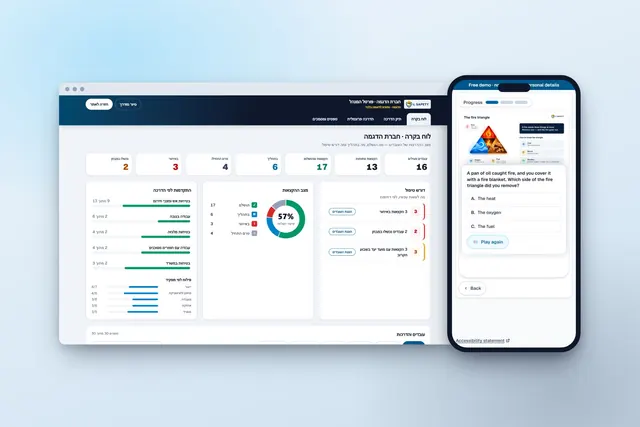
What to check before choosing an online safety training platform, what it does not do, and when Israeli law allows safety training by e-learning.

Present a training from the system on a projector; employees answer on their phones in their own language, and an attendance list and a session report are saved.

Foreign workers, new immigrants and multilingual teams: each employee chooses their language and gets the same content, the same exam and the same records.

A training register under the regulations with the Schedule forms, and records for every employee — signed lists, employee files and Excel — ready for an inspection.
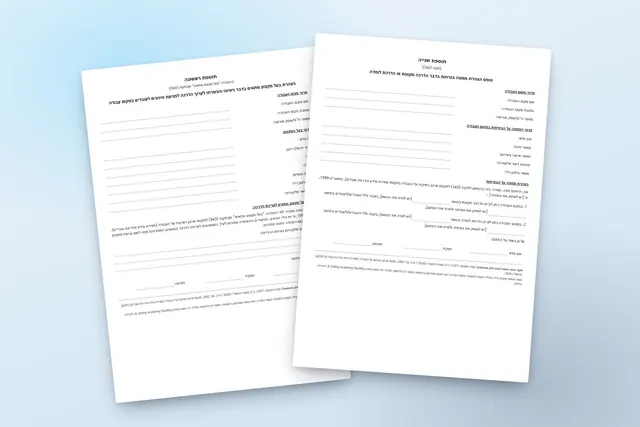
The First Schedule and Second Schedule forms of the regulations, in their official wording — blank, for printing, free of charge.
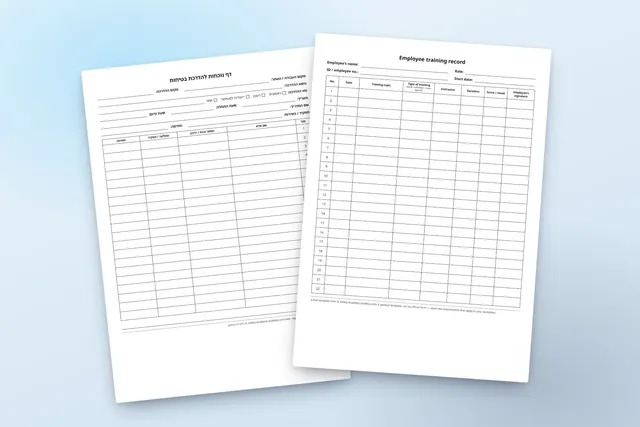
A safety training attendance sheet and an employee training record — blank PDF templates to print, free of charge, in ten languages.

Training for every employee in their own language: the prohibition in the law, the code of conduct and the details of the organisation's person in charge of complaints, acknowledged and signed.

A Word procedure becomes an accessible page on the phone: the employee reads, takes a short quiz and signs, and a signed receipt is kept for each employee.

Every training a new employee needs — safety, procedures and harassment prevention — in one assignment and in their own language.

From your presentation, procedure or know-how — a digital course with narration, an exam and versions in your employees' languages.